
BYD Yangwang Altior Review
Explore the BYD Yangwang Altior review covering its luxury, four-motor tech, performance, range, and ownership insights in this ultra-luxury electric
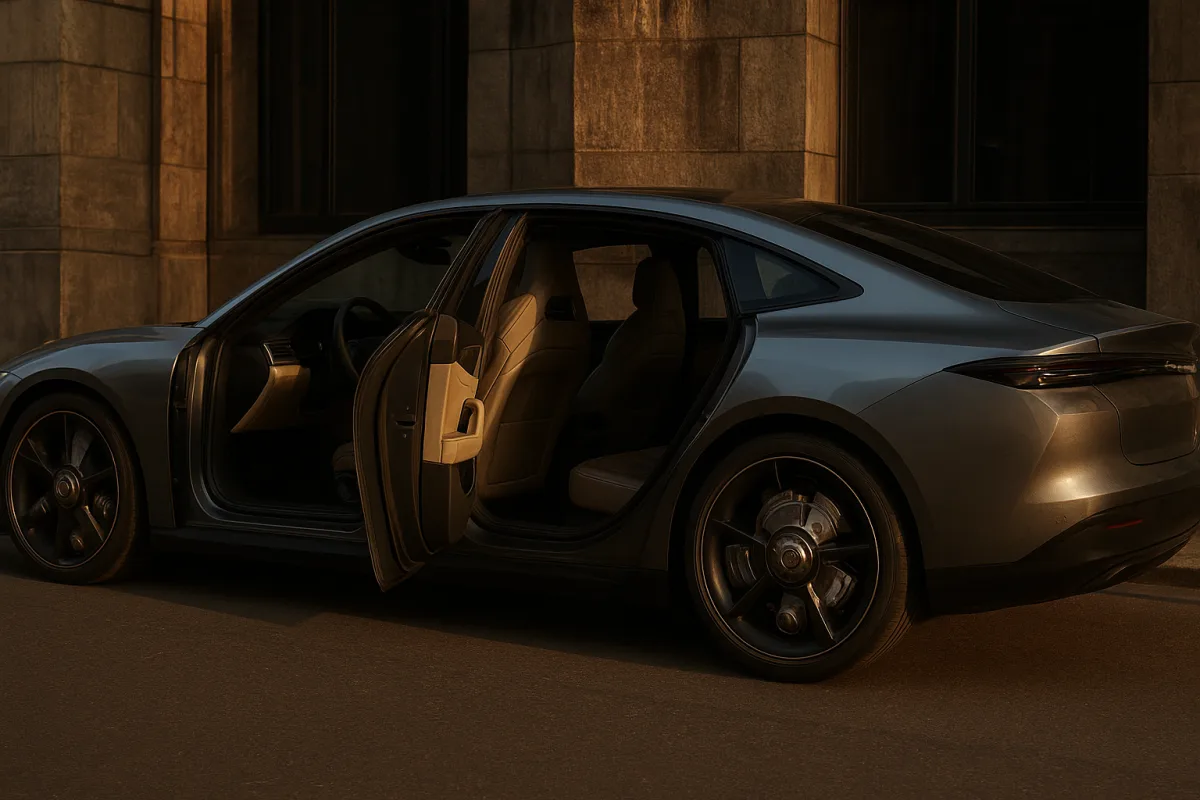
Four motors are the Altior’s real technical story
The Altior is 220.5 inches long, with a 137.8-inch wheelbase and rear doors that open to 90 degrees. Those are limousine numbers, but the engineering feature that separates it from a conventional luxury EV is its four-motor e4 platform.[3]
Most electric cars use one motor per axle, or occasionally a motor for each rear wheel. The Altior uses one motor at every wheel, so the car can control each tire’s driving or braking force independently.[3]
That is torque vectoring, taken further than the usual marketing phrase. Instead of sending broadly shared power through a differential, software decides what each wheel should receive, and BYD says it recalculates that decision over 100 times per second.[3]
In a long, heavy luxury sedan, this could matter more than a headline acceleration time. BYD has not published the Altior’s total power output, battery capacity, or 0-62 mph figure, so anyone quoting performance numbers is guessing.
How a tank turn actually works
A tank turn asks the wheels on one side of the car to turn forward while those on the other side turn backward. If grip is low enough, the vehicle rotates around a point near its center, like a tracked vehicle steering in place.
With a conventional all-wheel-drive EV, the front and rear axles can vary their output, but neither axle can fully separate its left and right wheels. Four motors give the Altior that left-to-right control, which is why the maneuver is possible.[3]
It is a party trick, but not an irrelevant one. The same hardware can respond to a developing skid, a split-grip road surface, or a sudden tire failure by reducing or increasing torque at individual wheels.
BYD says the system can help keep the Altior stable during a high-speed tire blowout.[3] The company has not published a speed, tire specification, or test procedure, so treat it as a claimed capability, not a replacement for sound tires.
The suspension has a bigger day-to-day job
Tank turns will attract attention in a showroom. The DiSus fully active body-control suspension is more likely to define whether the Altior feels properly expensive when it reaches a patched road or a long highway sweep.
The system uses information about the road ahead to adjust the adaptive suspension in real time, aiming to isolate occupants from bumps, pitch, and body roll.[3] That is the right target for a 5.6-meter chauffeur-oriented sedan.
Active suspension can hold the body level under braking and acceleration, then soften its response over sharp surface changes. Its challenge is not just comfort, but making the adjustments without producing the artificial, busy sensation that some active systems create.
BYD has not published component access, repair procedures, service pricing, or long-term durability data for the Altior’s suspension. For an owner keeping one past warranty, those omissions matter more than whether it can rotate in a parking lot.
A four-motor drivetrain also means four traction motors, four inverters, more cooling circuits, and extensive control software. There is no Altior ownership data yet, so there is no honest maintenance-cost forecast beyond saying that complexity rarely becomes cheaper at year eight.
Luxury by the rear seat, not the driver’s stopwatch
The Altior is intended as a four-seat limousine. Its rear compartment has 13.9 inches of knee room and 47.6 inches of legroom, along with reclining, massaging zero-gravity seats and a 21.4-inch ceiling-mounted entertainment screen.[3]
A one-button relaxation program reclines the seats, raises leg rests, closes sun blinds, alters the ambient lighting, and activates massage and fragrance functions.[3] This is aimed squarely at the Rolls-Royce and Mercedes-Maybach style of owner-driven or chauffeur-driven use.
BYD has specified full-grain semi-aniline leather, natural wood, pure-wool floor mats, real metal switches, silk embroidery, and yellow Hetian jade around the air vents.[3] There are 48 decorative pieces across 11 cabin locations, following more than 30 design iterations, according to BYD.[3]
The audio system has 39 speakers, including tweeters that rise and rotate at startup. There are refrigerators front and rear, while the 5.5-liter rear unit can either cool or warm its contents.[3]
Its 532-liter trunk is substantial for a car organized around rear-seat comfort.[3] Archie Hamilton Racing, attending the Abu Dhabi reveal, found the Altior’s scale and road presence immediately obvious, although barriers prevented a proper interior inspection at the event.
The screen-heavy dashboard is a concern for anyone who plans to keep this car for a decade. Displays date quickly, and their replacement after warranty can be very different from refurbishing leather, wood, or a conventional analog instrument cluster.
Range claims and the five-minute charging figure
BYD claims more than 1,000 km, or 621 miles, of range under the Chinese CLTC cycle.[3] That test is gentler than WLTP, and particularly gentler than the U.S. EPA procedure, so the number cannot be read as a likely 621-mile road-trip range.
No independent real-world Altior test has been published, and BYD has not disclosed the battery’s usable capacity. Until those two figures exist, you cannot calculate the car’s consumption or establish a realistic winter highway range.
BYD’s second-generation Blade Battery supports its Flash Charging system.[3] The company’s 1,500 kW charging network has been reported as capable of adding 249 miles of range in five minutes, but that figure depends on a compatible megawatt charger and the relevant battery’s charging curve.[7]
That is the central ownership limitation. A car can be engineered for extraordinary charging speed, but it only delivers that experience where compatible chargers exist, are working, and are available when you arrive.
At home, the Altior will behave like every other large-battery EV: it will spend far more time charging at modest AC power than at a headline-grabbing megawatt station. BYD has not yet published Altior-specific home charging times.
The price is clear, the ownership bill is not
The Shanhe Dingyun Limited Edition starts at 2.08 million yuan, approximately $310,000, in China.[1] It is limited to 399 cars worldwide, requires a 300,000 yuan deposit, and deliveries are expected in the second quarter of 2027.[1]
That price buys the vehicle itself, not an imported, registered, insured car in another country. BYD has not announced Altior pricing for the United States or United Kingdom, nor has it confirmed Altior sales in either market.
An Executive Edition has been shown, but its price and availability have not been published.[1] We would not place money against an unpublished export model, especially one whose long-term parts, repair, software, and insurance arrangements remain unknown.
The UAE is confirmed as a Yangwang market through Al-Futtaim, while the UK launch plan currently names the Yangwang U8 SUV for 2027, not the Altior.[1] An Abu Dhabi debut signals export ambition, but it does not amount to a retail commitment.
The Rolls-Royce resemblance, and the actual BYD court case
The Altior’s upright proportions, long hood, coach doors, two-tone paint treatment, chrome detailing, and disc-style 21-inch wheels invite Rolls-Royce comparisons.[3] It is 55 mm longer than a Rolls-Royce Ghost, although 162 mm shorter than a standard-wheelbase Phantom.[3]
BYD says the design takes inspiration from the ding, an ancient Chinese ceremonial bronze vessel associated with authority and dignity.[3] The grille replaces a Rolls-Royce-style mascot with Yangwang’s oracle-bone-script emblem, and its lighting has 12 rotating sequential elements.[3]
There is no reported legal dispute between BYD or Yangwang and Rolls-Royce over the Altior. The design may divide opinion, but resemblance alone is not a court case, and neither company has announced proceedings over this sedan.
The legal battle involving BYD is instead with Jaguar Land Rover, and concerns the boxy Fangchengbao Ti7 plug-in hybrid SUV, sold in China since September 2025. JLR alleges BYD copied or reverse-engineered technology from the Land Rover Defender.
Court-appointed bailiffs reportedly seized digital records from BYD offices in Schiedam and Hoofddorp, Netherlands, after JLR sought to preserve material it believed could be relevant. BYD’s lawyers described the seizure as a fishing expedition and said too many files were taken.
The preliminary hearing in The Hague is expected to establish whether BYD has a case to answer for intellectual-property infringement. Both JLR and BYD have said they will not comment on ongoing proceedings.
That distinction is important for an Altior buyer. The sedan’s Rolls-Royce-like design has created plenty of commentary, but the live litigation concerns an entirely different BYD vehicle and allegations extending beyond exterior styling.
Where we would stand
The Altior looks like a serious technical statement: enormous cabin room, unusually ambitious suspension hardware, and a four-motor system with capabilities that are more substantive than a refrigerator or a rotating tweeter. Its materials list also sounds appropriate for the price.
We would wait. At $310,000-equivalent money, the unanswered questions are battery capacity, independently verified range, charging performance away from a demonstration network, repair support, insurance, software longevity, and residual value.
Luxury buyers can accept complexity when a manufacturer has an established service network and a record of supporting cars long after the launch event. Yangwang has not yet built that record outside China, and the Altior needs time to earn it.
Frequently Asked Questions
What are the key features of the BYD Yangwang Altior?
The Altior is a 220.5-inch-long luxury sedan with a 137.8-inch wheelbase and rear coach doors that open 90 degrees. It features a unique four-motor e4 platform with one motor at each wheel, enabling advanced torque vectoring. The interior is designed for rear-seat luxury with reclining, massaging zero-gravity seats, a large entertainment screen, and high-end materials like full-grain leather, natural wood, and yellow Hetian jade accents.
How does the BYD Yangwang Altior's four-motor system work?
Each of the four wheels has its own independent motor, allowing the car to control driving and braking force individually at each tire. This system recalculates torque distribution more than 100 times per second, enabling maneuvers like tank turns and improving stability during events such as tire failures. This level of control goes beyond typical torque vectoring by managing power at each wheel separately.
What luxury amenities does the Yangwang Altior offer?
The Altior’s rear cabin includes 13.9 inches of knee room and 47.6 inches of legroom with reclining, massaging zero-gravity seats. It has a 21.4-inch ceiling-mounted entertainment screen and a one-button relaxation program that adjusts seats, leg rests, sun blinds, lighting, massage, and fragrance. The interior features premium materials such as full-grain semi-aniline leather, natural wood, pure-wool floor mats, real metal switches, silk embroidery, and 48 decorative pieces including yellow Hetian jade around the air vents.
What is the real-world range of the BYD Yangwang Altior?
BYD claims a range of 1,000 kilometers (621 miles) based on China’s CLTC test cycle, which is known to be optimistic. Real-world range is expected to be lower, but independent testing results have not yet been published. Therefore, actual driving range outside the CLTC cycle remains to be verified.
How does the BYD Yangwang Altior compare to Rolls-Royce?
The Altior is positioned as a rival to ultra-luxury sedans like the Rolls-Royce Ghost, especially in terms of size, rear-seat luxury, and price. While it shares some styling cues such as coach doors, BYD attributes its design inspiration to an ancient Chinese bronze vessel rather than Rolls-Royce. There is no public information about any legal dispute between BYD and Rolls-Royce regarding the Altior’s design.
How we researched this
This article was assembled from 1 video source, 8 published articles, 16 cited references.
Nothing here is based on hands-on testing. Where a figure or finding appears, it belongs to the source cited beside it, and the writing says so rather than implying otherwise. Every source is listed below so you can check it.
Sources
NEW Yangwang Altior FIRST LOOK! BYD's Rolls-Royce RIVAL!, Archie Hamilton Racing
UK government set to ease electric vehicle sales targets this week, Autocar
BYD's Yangwang Altior Is A $310k Rolls-Royce Copycat That Can Tank-Turn, CarScoops
Land Rover Thinks BYD Copied The Defender. Now There's A Court Battle: Report, Motor1
BMW could build V8 Alpina concept as luxury brand's 'M1 moment', Autocar
BYD's New Flagship Sedan Wants To Be China's Most Luxurious Car Yet, Motor1
Own your dream car fleet for less, by fixing them yourself, Autocar
No more idling: The £200k EV ice cream van making summer quieter and cleaner, Autocar
A green ice cream? The British firm turning ice cream vans electric, Autocar
BYD Yangwang debuts Altior, targeting ultra-luxury executive sedan market - CnEVPost
Yangwang Altior Revealed: BYD’s $310,000 Rolls-Royce Ghost Rival
You're driving your electric car wrong - here's how to get the best efficiency out of it
Yangwang Altior Revealed With Four Motors and Claimed 1000km-Plus Range | CarSauce
Lucid Air Long-Term Ownership Cost: 5-Year Guide | Recharged
Lucid Air Resale Value in 2026: Depreciation, Range & Ownership Cost Reality | AutoEdgeView
Yangwang Altior: electric luxury sedan revealed | AutoScout24
YANGWANG ALTIOR makes its global debut in Abu Dhabi: a higher expression of power - BYD
Review launched to shape pathway to reach zero emission driving by 2035 - GOV.UK
Yangwang Altior is a palace on wheels with Rolls-Royce in its sights
Watch BYD Yangwang Altior: The Ultra-Luxury Electric Sedan Rivaling Rolls-Royce on Youtube
Related Articles
2027 BMW 3 Series M350 vs i3
Compare the 2027 BMW 3 Series M350 and i3 models on performance, ownership costs, and market challenges to find which suits your needs best.
Volkswagen ID.3 GTI Review: Electric Performance and Updates
Explore the Volkswagen ID.3 GTI's electric performance, key updates, and what to expect from ownership and driving experience.

Mercedes-AMG CLE 646 Ownership
Explore Mercedes-AMG CLE 646 ownership, including performance, maintenance, costs, and the driving experience of this exclusive V8 coupe.
2027 Range Rover Electric Review: Performance and Ownership
Explore the 2027 Range Rover Electric review covering performance, range, price, off-road ability, and ownership insights.