
Electric Camper Vans
Explore electric camper vans like the Volkswagen ID California Cruise and learn about EV camping features, range, and maintenance tips.
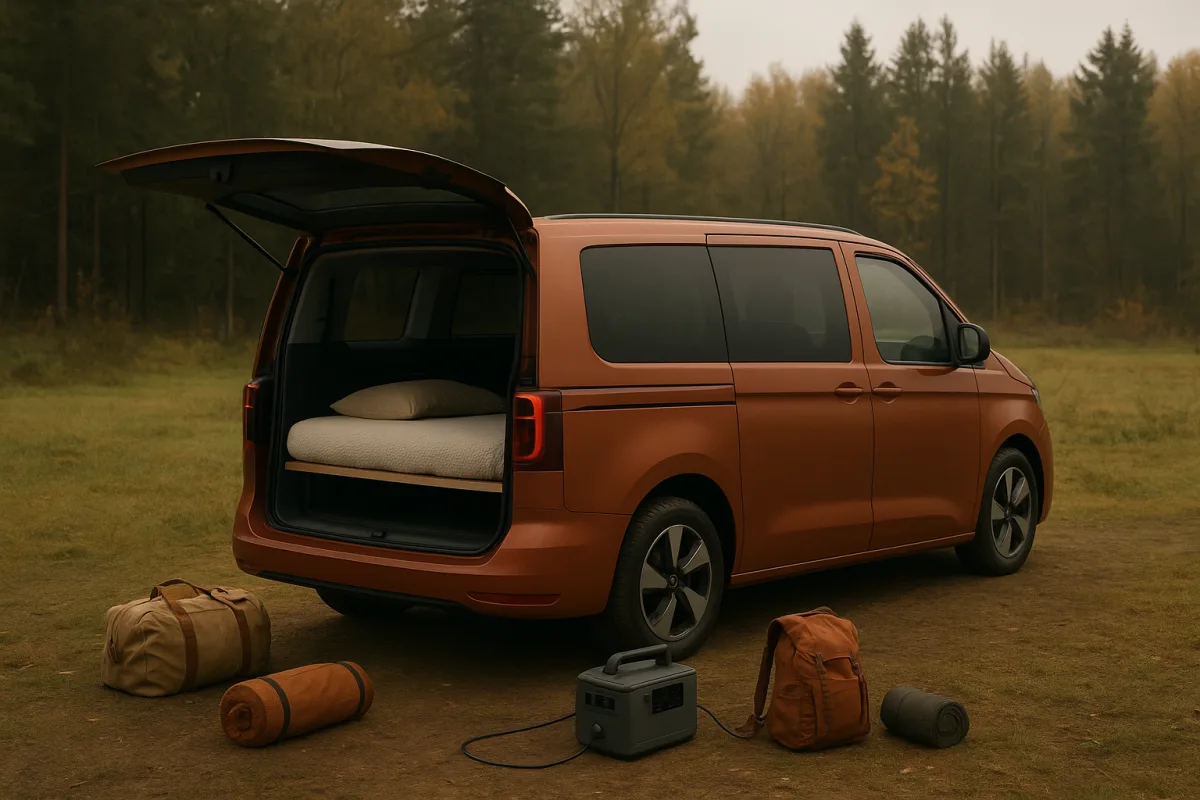
The shift is real, but it is starting at the lighter end of camping
Electric camper vans are moving from conversion-shop experiments into manufacturer catalogues. Volkswagen Commercial Vehicles has now put an electric California badge on an ID. Buzz-based product, while the American market is being prepared for a related ID. Buzz Tourer camping trim. [2][6][7]
That matters because the California name has usually meant a self-contained compact camper: bed, cooking arrangement, storage, and a layout intended to be lived in rather than merely slept in. The ID. California Cruise is a more cautious first step.
Carscoops describes it accurately as an ID. Buzz with a bed. It adds a folding rear mattress, blinds, ventilation panels, table and chairs, but it does not add the kitchen, pop-top roof, swivelling front seats or integrated camping furniture expected in fuller California models. [2]
That may sound like Volkswagen hedging, and it is. But it is also a sensible response to the awkward part of electrifying a camper van: the traction battery has to move the van, heat or cool it overnight, and potentially run appliances.
The same pattern is appearing across EV camping culture. Rather than launching battery-electric replicas of large diesel motorhomes, manufacturers and converters are first selling overnight packages, removable kitchens, portable induction equipment and vehicle-to-load power. The van remains transport first.
I have not driven the ID. California Cruise, and nobody outside Volkswagen has yet accumulated meaningful ownership mileage in one. The useful question is therefore not whether it will feel futuristic on a launch route, but whether its compromises suit the way you camp.
What Volkswagen is actually selling
The German-market Volkswagen ID. California Cruise starts at €60,761, according to AutoScout24 and Car-Newsdesk, with deliveries expected in early 2027. That is a starting vehicle price, not a finished expedition budget including options, home charging equipment, insurance, campsite electricity or accessories. [3][8]
It is based on the ID. Buzz Pro and is offered in short- and long-wheelbase forms. Its rear platform contains a tri-fold mattress measuring 2.03 metres long and 1.20 metres wide, which is adequate for two cooperative adults but narrow by conventional camper standards. [2][3]
Volkswagen includes blackout curtains, front-window ventilation inserts, a folding table and two camping chairs stored beneath the bed platform. Those are useful items because they avoid the usual first-weekend shopping list, but they do not create additional enclosed living space. [2][8]
The carmaker’s retained-power camping mode can keep lights, USB charging and climate control operating for up to 48 hours. That is not a guaranteed two-night stay, because starting state of charge and outside temperature determine the result. [2][3]
There is also disagreement in early reporting over vehicle-to-load output. Carscoops reported up to 2,000 watts, while InsideEVs reported a 3.6 kW peak through Volkswagen’s PowerSocket adapter. Until Volkswagen publishes market-specific final specifications, assume neither figure tells the whole campsite story. [2]
Either output is enough for modest loads, such as charging devices, a compressor cooler, coffee maker or low-power induction cooking. It is not the same thing as installing a domestic electrical system and behaving as though the van has an unlimited shore-power hookup.
The ID. California Cruise suits couples or solo travellers who normally drive to a destination, stay one or two nights, and value quiet overnight climate control. It does not suit buyers wanting a washroom, permanent galley, long winter autonomy or family-sized sleeping accommodation.
Range is the constraint that matters after the brochure closes
Volkswagen’s quoted long-wheelbase WLTP range is 481 km, or 299 miles. That is a lab-cycle figure, and it is especially unhelpful for a camper because the vehicle is likely to be loaded, driven at motorway speed and used as an overnight power source. [3]
The independent research available so far suggests allowing about a 20 percent reduction under typical camping use, producing a planning estimate around 385 km, or 239 miles. That is an estimate derived from general EV efficiency evidence, not a tested ID. California Cruise result. [4][5]
That distinction is worth making plainly. No independent real-world camping-range tests exist yet because customer deliveries have not begun, so nobody can honestly tell you what happens after eight hours of heating at freezing temperatures, followed by a wet motorway run.
For an owner, the difference between 299 and 239 miles is not academic. It changes whether a Friday evening escape involves one relaxed charging stop, a charge near the campsite, or a shorter destination chosen around dependable public infrastructure.
Heating and cooling are where electric camping becomes less romantic than the advertising. An EV can provide silent climate control without idling an engine, which is a genuine benefit, but that comfort comes directly from the same battery reserve needed for tomorrow’s route.
A sensible trip plan leaves a buffer after arrival rather than pulling onto a remote pitch at five percent state of charge. You may not need to drive that evening, but a blocked exit, poor weather, medical issue or closed charger can make reserve energy valuable.
The alternative is changing the camping style. Drive shorter daily legs, use sites with destination charging, travel in milder weather, carry less unnecessary weight and choose routes with more than one workable fast-charging option. That is touring, not traditional fuel-station freedom.
The American version is related, not identical
American readers should not assume that the German ID. California Cruise will simply appear at a local Volkswagen dealer. Electrive and U.S. conversion specialist OZK Customs both indicate that the Cruise itself is not planned for U.S. sale. [6][7]
Instead, Volkswagen has signalled an ID. Buzz Tourer-style model for the U.S., expected from late 2026 or with the returning 2027 ID. Buzz range. It is expected to bring a fold-out mattress, blinds, ventilation panels, outdoor table and chairs. [7][10]
The U.S. ID. Buzz Tourer suits the same occasional overnighter as the European Cruise. Its price is not yet published, and neither are final battery, charging and camping-power details, so it cannot be responsibly compared dollar-for-dollar with a diesel conversion today.
Volkswagen paused U.S. ID. Buzz production for the 2026 model year before planning its return for 2027. That makes any dealer promise about Tourer delivery timing, finance terms or incentives something to verify in writing rather than a basis for ordering accessories. [10][13]
Volkswagen Retail Finance offers financing for its existing EV range with terms from 12 to 84 months, but there is no specific U.S. finance program for an ID. California Cruise because the vehicle is not being sold there. [13]
What changes for a DIY camper project
For someone planning their own EV camper project, the biggest change is electrical architecture. In a diesel conversion, the leisure battery system can be treated as a separate small household. In an EV, the traction battery may already provide climate control and exportable power.
That sounds simpler, but access matters. Do not assume a charge-port adapter, vehicle-to-load function or overnight climate mode is standard on every electric van, or that it works while the van is locked and unattended. These are model- and market-specific features.
A modest removable build is the lower-risk route while this market matures. Think bed platform, insulated window covers, ventilation, compressor cooler, portable cooking equipment and storage, rather than cutting the roof or building a heavy permanent galley before understanding the vehicle’s payload and energy use.
Weight deserves more attention than it gets in glamorous conversion videos. A mattress, drawers, water, food, bikes and camping hardware can reduce efficiency, consume payload and accelerate tyre wear. In an EV camper, every unnecessary kilogram has a practical route-planning cost.
There is no model-specific long-term maintenance evidence for the ID. California Cruise. Estimates from electric delivery vans put annual maintenance at roughly €800 to €1,500, against €1,500 to €2,500 for diesel vans, but a leisure vehicle’s use pattern is different. [11]
The recurring jobs are not mysterious: tyre rotations commonly cost $40 to $100 every 6,000 to 8,000 miles, and cabin filters are often $50 to $130 annually. EVs can wear tyres 20 to 30 percent faster because of weight and torque. [12]
The small 12-volt battery is another unglamorous ownership item. Delivery-van estimates suggest replacement every three to four years at roughly €100 to €150, and a flat auxiliary battery can immobilise a very sophisticated electric vehicle just as effectively as an engine fault. [11]
Off-grid camping still follows the same rules
Electric campers do not currently face a separate federal category of off-grid restrictions in the United States. On Bureau of Land Management land, dispersed camping is generally limited to 14 days within a 28-day period, after which campers must relocate. [1]
The BLM also requires vehicles to remain on designated roads and trails unless an area specifically permits off-road travel. An EV does not make a rough access track less damaging, and its extra mass may make soft ground or steep, loose tracks less appealing. [1]
The key operational difference is energy, not permission. A diesel camper can usually solve a poor plan by carrying more fuel, while an electric camper needs either a charger, enough battery reserve, or a willingness to reduce heating, cooling and appliance use.
That is why the first credible electric campers look relatively restrained. The Volkswagen ID. California Cruise is not trying to replace every conventional motorhome. It is testing whether an electric van can make weekend camping cleaner, quieter and less mechanically complicated without pretending range no longer matters.
Frequently Asked Questions
What features does the Volkswagen ID California Cruise offer?
The ID. California Cruise includes a folding rear mattress measuring 2.03 by 1.20 meters, blackout curtains, front-window ventilation panels, a folding table, and two camping chairs stored under the bed platform. It lacks a built-in kitchen, pop-top roof, swiveling front seats, or integrated camping furniture, focusing on providing a bed and basic camping essentials rather than a full motorhome setup. The vehicle also has a camping mode that can supply power for lights, USB charging, and climate control for up to 48 hours.
How far can electric camper vans like the ID California Cruise travel?
The official WLTP range for the long-wheelbase ID. California Cruise is 299 miles (481 km), but real-world camping conditions such as climate control use and added weight typically reduce this by about 20%. A practical estimate of usable touring range is therefore around 239 miles (385 km) or less, with comprehensive real-world data expected only after deliveries begin in early 2027.
Is the ID California Cruise suitable for long-term camping?
The ID. California Cruise is best treated as an electric day van with a proper bed rather than a fully equipped motorhome. It lacks permanent living features such as a kitchen or pop-top roof, making it more suitable for short-term or light camping rather than extended stays. Its design prioritizes transport and overnight accommodation rather than full-time camping comfort.
What are the maintenance considerations for electric camper vans?
There is currently no reliable long-term maintenance data specifically for electric camper vans. However, owners should budget for typical EV maintenance items such as tire replacement, 12-volt battery replacement, and routine cabin servicing. Maintenance costs are generally informed by data from electric delivery vans, but specifics for camper vans remain to be established.
How practical is off-grid camping with an electric camper van?
Off-grid camping with an electric camper van like the ID. California Cruise is practical when charging infrastructure is integrated into the travel route. However, using battery-powered heating, air conditioning, and cooking appliances requires careful range planning, as these functions consume significant energy and can reduce driving range.
How we researched this
This article was assembled from 3 published articles, 13 cited references.
Nothing here is based on hands-on testing. Where a figure or finding appears, it belongs to the source cited beside it, and the writing says so rather than implying otherwise. Every source is listed below so you can check it.
Sources
VW Turned The ID. Buzz Into An Electric Camper Van. The U.S. Is Next. — InsideEVs
BMW’s iX3 Locks Doors Briefly To Stop Cyclist Collisions — Motor1
VW’s First Electric California Is An ID. Buzz With A Bed — CarScoops
VW’s First Electric California Is An ID. Buzz With A Bed | Carscoops
VW ID. California Cruise (2027): Der Buzz wird zum Spar-Camper. - AutoScout24 Deutschland
ID. California Cruise : l'autonomie électrique face au défi du camping itinérant
You're driving your electric car wrong - here's how to get the best efficiency out of it
The electric camper van ID. California Cruise is on it's way! - electrive.com
New VW Camper Vans for Sale in the USA: What You Can Actually Buy | OZK Customs
Caravan Salon: Here's How Much the First Fully Electric VW Camper Costs - Car-Newsdesk
VW ID. California Cruise: E-Camper ab 60.761 Euro – GoingElectric.de
VW’s ID Buzz Electric Microbus Is Dead for 2026—but It’s Not Gone for Good
What does maintenance on an electric delivery van cost per year? - Autobedrijven Verdonk
EV Maintenance Cost in 2026 | What You Actually Pay Per Year
Related Articles
Ford 2027 Bronco Filson and Fathom EV
Explore Ford's 2027 Bronco Filson and Fathom EV, including specs, pricing, and innovations in EV platform and ownership experience.
New Electric and Hybrid SUVs: Reviews and Comparisons
Explore reviews and comparisons of new electric and hybrid SUVs, covering performance, ownership costs, range, and driving experience.
2027 Range Rover Electric Review: Performance and Ownership
Explore the 2027 Range Rover Electric review covering performance, range, price, off-road ability, and ownership insights.
BMW Electric Vehicle Sales Milestone and Neue Klasse iX3
Explore BMW's electric vehicle sales milestone and the Neue Klasse iX3's range, ownership, and impact on Europe's EV market.