
Land Rover Defender Pickup Collaboration Details and Impact
Explore the Land Rover Defender pickup collaboration with Stellantis, production plans, tariff impact, and platform choices in this detailed update.
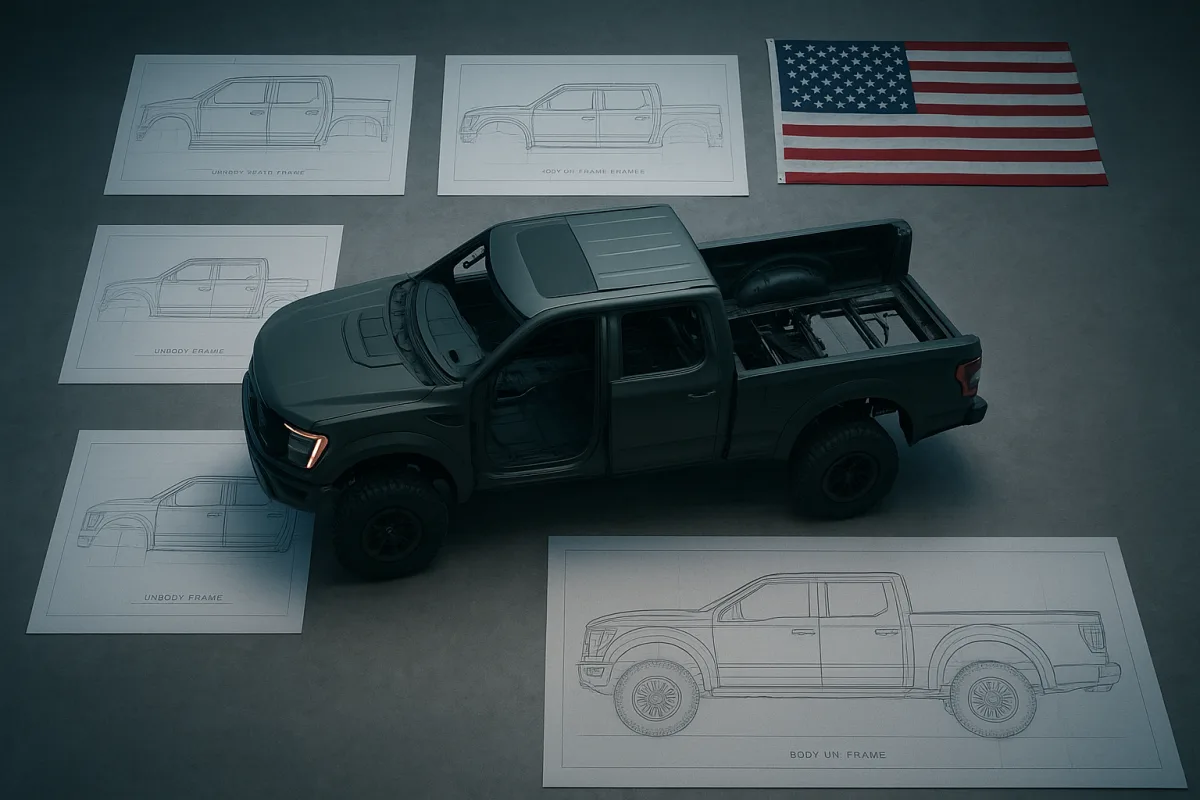
The important number is 25 percent
The easy reading of this story is that Land Rover wants a pickup because Americans buy pickups. That is true enough, but it misses the commercial mechanism driving the project: the 25 percent tariff on imported light trucks.
This is usually called the Chicken Tax, a tariff created in the 1960s amid a trade dispute over imported chicken. The poultry argument disappeared decades ago, but the duty on imported pickups remained, protecting a market dominated by locally built trucks.
For a conventional imported passenger car, the tariff picture is different. Car and Driver reports that JLR’s U.K.-built models face a 10 percent duty and its EU-built vehicles, including the Slovakian-built Defender, face 15 percent. [5]
An imported Defender pickup would face the light-truck tariff instead. That is the difference between a tax that hurts a margin and one that can make the entire business case fail before the dealer has added floor mats.
Take a deliberately simplified example. If a manufacturer needed a $55,000 landed cost before the truck reached a dealer, a 25 percent tariff adds $13,750. That is not a trim-level option or a small price adjustment.
It becomes part of the vehicle’s basic cost structure. The manufacturer can absorb some of it, but doing so reduces profit. It can pass it to the buyer, but then a premium truck is suddenly competing at an awkward price.
That is why a U.S. factory is not merely a patriotic production decision. Assembly in America can remove the pickup-specific tariff from the calculation, provided the vehicle qualifies under the relevant rules, and makes a Defender-branded truck viable at all.
It also explains why JLR is not simply transferring current Defender SUV production from Slovakia. Car and Driver reports that the intended collaboration is instead about developing Defender vehicles for new segments, with a U.S.-oriented pickup apparently first. [5]
That distinction matters. The existing Defender 90, 110 and 130 are SUVs. A pickup needs a separate program, separate certification work, a manufacturing plan, and a decision about what it is supposed to do better than a luxury SUV.
A memorandum is not a truck
Jaguar Land Rover and Stellantis signed their memorandum of understanding in May 2026. The reporting so far describes an agreement to explore U.S. product development and production, rather than a final, public manufacturing contract. [5]
This is early-stage work, and readers should keep that in mind when encountering confident renderings, dealer gossip or supposed trim lists. JLR has declined to comment on future product reports, while the companies have not confirmed a factory or technical package. [5]
The most specific reporting points to a Defender pickup built in the United States with Stellantis involvement. Automotive News reporting cited by Motor1 floated Stellantis’s Belvidere, Illinois, facility, but neither company has publicly confirmed that location.
That means Belvidere is a possibility, not a production announcement. The same caution applies to Ram engines, Jeep components, plug-in hybrid systems, V8s, diesel engines, electric versions and claims that a Dakota or Ram chassis is already chosen.
No pickup price or trim structure has been released. There is not even an official confirmation that the finished vehicle will use the Defender name exactly as reports suggest, though that appears to be the direction of travel.
For context only, the current 2026 Defender 130 SUV range runs from the S through X-Dynamic SE, Outbound, X and V8 models. Land Rover Brooklyn lists prices from $74,850 to $125,750 before destination charges. [2]
The Defender 130 Outbound deserves a clarification because its name can confuse this discussion. It is a cargo-oriented, two-row SUV, not a pickup. It retains an enclosed body rather than offering an open bed. [2]
A future truck might cost less, similar money, or substantially more than those SUVs. There is no honest way to predict that from present information, especially before Land Rover chooses its structure, engine family, equipment level and production volume.
Why the chassis choice decides the whole truck
The partnership’s unresolved platform decision is the real story. It determines whether the result behaves like a Defender with a practical rear bed, or like a Ram-derived pickup wearing a Land Rover body and interior.
Today’s Defender uses a unibody structure. In a unibody vehicle, the passenger cell, floorpan, structural rails and much of the crash structure are engineered as one integrated body shell. That can make for stiffness, good road manners and efficient packaging.
A pickup usually uses body-on-frame construction. The Ram 1500, Ram heavy-duty trucks and Jeep Gladiator use a separate ladder frame, with the cab and bed mounted above it. Car and Driver notes that Stellantis does not currently build a unibody pickup. [5]
That matters because an open pickup bed changes how loads reach the vehicle. A traditional ladder frame carries towing forces, payload weight and twisting loads along its rails. The separate bed can flex slightly without being the primary structural member.
A unibody pickup can work, but it requires careful engineering around the missing rear roof structure. Removing the enclosed SUV body’s rear section changes stiffness, noise paths and crash performance, particularly in offset impacts and rear-end collisions.
The question is not whether either format is inherently superior. It is what the Defender pickup is meant to be. A unibody design could preserve the current Defender’s more polished road behavior and potentially lower step-in height.
A body-on-frame design could offer a clearer route to hard-work towing and payload figures, plus an easier path to familiar American pickup manufacturing. It could also share more parts with Stellantis trucks, which is usually where partnership savings come from.
Shared parts do not just mean a chassis. They can include seat structures, wiring architecture, braking components, electronics, HVAC systems, supplier contracts, powertrain interfaces and factory tooling. Every shared component can reduce development spending and lead time.
But there is a limit. Land Rover cannot sell a six-figure Defender truck successfully if it feels like a lightly retrimmed mainstream pickup. Buyers will notice calibration, cabin isolation, low-range behavior, steering response, door feel and the way suspension behaves unloaded.
This is why the platform decision affects ownership too. Shared Ram or Jeep mechanical parts could potentially improve North American parts availability and give independent repairers more familiarity. That is plausible, but it remains unproven until the bill of materials exists.
It could also create the opposite problem. A bespoke blend of JLR electronics, Land Rover off-road systems and Stellantis hardware might leave dealers diagnosing systems across two corporate ecosystems, which is never ideal once warranties expire.
American production does not remove compliance costs
A Defender pickup built in America would avoid one tariff problem, but it would not avoid American regulation. The truck must meet emissions, fuel-economy and safety standards applicable to its category and model year.
The EPA’s greenhouse-gas standards become more stringent from model year 2027 for light-duty vehicles, including pickups. [1] That makes the engine choice more consequential than it would have been a few years ago.
A large-displacement gasoline engine may be valuable for towing character and brand image, but it makes fleet compliance harder. A hybrid system, a plug-in hybrid or an electric version could help the manufacturer’s arithmetic, but each changes weight and packaging.
Battery packaging is especially relevant in a truck. Put a large battery beneath the floor and it can affect ground clearance, frame design, underbody protection and payload. Put it elsewhere and cabin or bed packaging suffers.
Safety certification brings similar constraints. Enhanced front-seat-belt warning requirements take effect in September 2026, with rear-seat requirements following in September 2027. Updated door-lock and retention requirements also apply from June 2026, according to the research briefing.
Pickup safety is not automatic simply because the underlying parts may exist elsewhere. MotorTrend reported that only two pickups had earned 2026 Top Safety Pick+ status as of April, a useful reminder that truck crash performance remains a difficult area. [4]
The current Defender is classified by the EPA as a Standard Sport Utility Vehicle 4WD, not as a pickup. Changing the body, weight distribution and rear structure creates another round of certification work, even if some hardware is shared. [3]
What ownership evidence can, and cannot, tell us
I have not owned or driven the proposed Defender pickup, because nobody outside the project can have done so. More importantly, there is no credible maintenance, reliability, insurance or resale data for an unreleased model.
The nearest useful evidence is the current Defender SUV range, but it should be treated as context rather than a forecast. Kelley Blue Book estimates maintenance for a Defender 110 at about $1,871 annually, or $9,358 over five years. [7]
That does not mean a pickup will cost $1,871 annually to maintain. A truck may use different engines, brakes, tires, suspension pieces, electronics and service schedules. Towing or off-road work can also make ownership diverge sharply from a commuter SUV’s pattern.
The current Defender’s resale performance is relatively strong by Land Rover standards. iSeeCars estimates it retains 51.3 percent of its value after five years, the best result within the Land Rover range it measured. [8]
Again, do not turn that into a promised pickup residual. Trucks can retain value exceptionally well when supply is constrained and the specification is right, but luxury pickups can also be niche vehicles with expensive options and uncertain second-owner demand.
The financial trap will be familiar to anyone shopping in the current market. Kiplinger notes that average new-vehicle transaction prices exceed $50,000, while lower-credit borrowers can face rates up to 12 percent and longer loan terms are increasingly common. [10]
That matters if the Defender pickup arrives at premium-SUV money. A 72- or 84-month loan can make the monthly payment look manageable, but it increases total interest and can leave an owner carrying negative equity long after the new-car novelty fades.
For now, the sensible position is simple. Watch the partnership for its platform decision, factory confirmation and powertrain announcement. Those three facts will tell us far more about the future Defender pickup than an early sketch or a speculative MSRP ever could.
Frequently Asked Questions
What is the Land Rover Defender pickup collaboration with Stellantis?
Jaguar Land Rover and Stellantis signed a memorandum of understanding in May 2026 to explore U.S. product development and production of a Defender pickup. The partnership aims to leverage Stellantis’ expertise in body-on-frame truck platforms to develop a pickup tailored for the U.S. market. However, no final agreements on platform, engine, or production details have been confirmed.
Where will the Land Rover Defender pickup be built?
The Defender pickup is planned to be built in the United States, with Stellantis’s Belvidere, Illinois, facility mentioned as a possible location. Neither company has publicly confirmed the factory site, so the exact production location remains unannounced.
How does the 25 percent tariff affect the Defender pickup?
Imported light trucks like pickups face a 25 percent tariff known as the Chicken Tax, which significantly increases their landed cost in the U.S. Building the Defender pickup domestically avoids this tariff, making the truck commercially viable by reducing costs that would otherwise hurt profit margins or raise prices substantially.
What platform options are being considered for the Defender pickup?
The key engineering question is whether the Defender pickup will retain the current unibody structure or adopt Stellantis’s body-on-frame platforms, such as those used for the Ram 1500 or Dakota. This decision will impact towing, payload, refinement, and repair costs, but no final platform choice has been announced.
Is there a confirmed launch date for the Land Rover Defender pickup?
No launch date has been confirmed. The project is in early stages, with only a memorandum of understanding signed and no official production or pricing announcements made.
How we researched this
This article was assembled from 5 published articles, 10 cited references.
Nothing here is based on hands-on testing. Where a figure or finding appears, it belongs to the source cited beside it, and the writing says so rather than implying otherwise. Every source is listed below so you can check it.
Sources
Land Rover and Stellantis Aim to Build a Defender Truck in the U.S. — Car and Driver
JLR-Stellantis Partnership Will Reportedly Result in a U.S.-Made Land Rover Defender Pickup — Road & Track
Jaguar Land Rover Plans US Defender Pickup Built With Stellantis, Sources Say — Motor1
Land Rover And Stellantis Will Team Up To Build A Defender Pickup In The U.S. — Jalopnik
The New Audi A2 Looks Charming Even As A Base Model — Motor1
Regulations for Greenhouse Gas Emissions from Passenger Cars and Trucks | US EPA
2026 Land Rover Defender Specifications, Engine & Powertrain | AutoUtility US
Land Rover and Stellantis Aim to Build a Defender Truck in the U.S.
Land Rover Defender Pickup Reportedly Coming | Could Be Built By Stellantis
Related Articles
2027 Off-Road and 4x4 Vehicles Comparison: Defender vs Ram
Compare 2027 off-road and 4x4 vehicles including the Land Rover Defender and Ram Power Wagon diesel for towing, performance, and ownership.
Ford 2027 Bronco Filson and Fathom EV
Explore Ford's 2027 Bronco Filson and Fathom EV, including specs, pricing, and innovations in EV platform and ownership experience.
Military-Inspired Off-Road SUVs
Explore military-inspired off-road SUVs like the Ford Bronco Filson, Defender Wolf II, and Land Cruiser with insights on ownership and performance.
Volkswagen Group Restructuring
Explore Volkswagen Group restructuring impact on ownership, model cuts, maintenance, and driving experience in this detailed analysis.