
Toyota Hydrogen Pickup: 2028 Hilux and Racing Plans
Explore Toyota's hydrogen pickup plans, including the 2028 Hilux range, towing, and Dakar racing development.
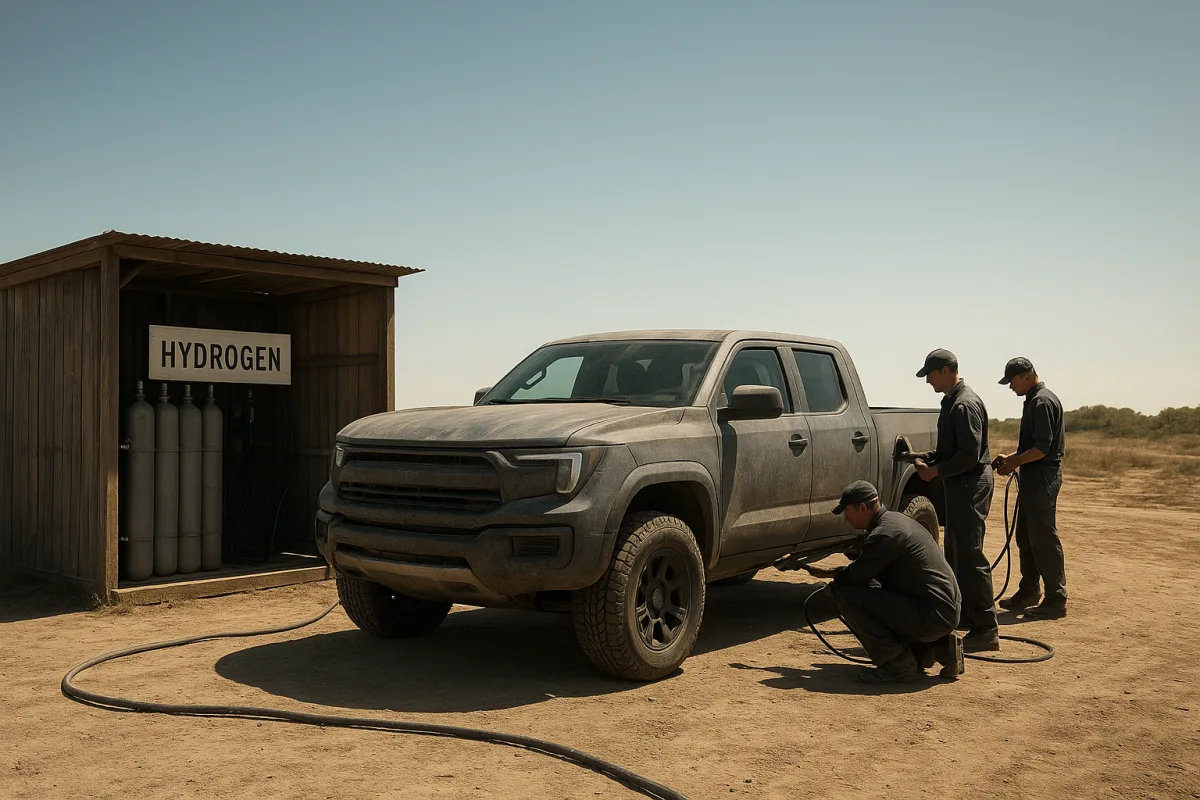
Toyota has moved hydrogen from demonstration to programme
Toyota is no longer treating a hydrogen Hilux as a laboratory curiosity. The company has confirmed that a fuel-cell version of the next-generation pickup will reach Europe by 2028, alongside battery-electric and mild-hybrid Hilux variants. [10]
That is a meaningful shift, although it needs qualifying. Toyota has built hydrogen Hilux prototypes before, including a 2023 development vehicle and a small 2024 test fleet, but a stated production date creates a different obligation. [1]
The second part of the shift is motorsport. Toyota Gazoo Racing intends to enter the DKR GR FC Hilux in the 2027 Dakar Future Mission 1000 programme, an alternative-energy event run alongside the principal Dakar Rally. [2]
Neither announcement proves hydrogen has won the pickup argument. Together, though, they show Toyota is spending development money on both the road vehicle and the difficult operating conditions that could expose its weaknesses early.
This is not happening in isolation. Toyota has also announced a third-generation fuel-cell system for introduction after 2026, promising twice the durability of its previous system, a 20 percent range improvement and lower costs. [9]
BMW is still publicly pursuing fuel-cell development too, previewing a hydrogen version of the iX5 with a claimed range of up to 385 miles. That does not make hydrogen mainstream, but it does show Toyota is not the last manufacturer funding it. [4]
The trend is therefore not “hydrogen is replacing batteries.” The evidence points to a narrower strategy: manufacturers are keeping fuel cells alive for applications where payload, refuelling time and high daily utilisation make battery compromises harder to accept.
Why a Hilux is a more credible hydrogen candidate than a city car
A pickup gives Toyota some packaging advantages that a small passenger car does not. The 2024 Hilux fuel-cell prototypes reportedly used three hydrogen tanks within the ladder-frame chassis and placed a lithium-ion battery beneath the bed. [1]
That underbody space matters, but it is not free space. Any owner who has lived with a working pickup knows that chassis-mounted equipment, spare wheels, tow bars, skid plates, auxiliary tanks and bed accessories soon compete for room.
Toyota’s production target is 400 kilometres, or 248 miles, on a full tank. The company also quotes a 2,500kg towing capacity, equivalent to roughly 5,512lb, for the fuel-cell model. [1][10]
Those are useful numbers only with several footnotes. Toyota has not published the test cycle behind the 400km figure, nor has it shown what happens to range while towing, carrying a canopy, running all-terrain tyres or operating in winter.
The earlier prototype reportedly managed 600km, or 373 miles, but it should not be read as a promise for the 2028 vehicle. Production models acquire safety equipment, final calibration, customer-use margins and sometimes different packaging. [1]
Toyota has also not confirmed whether the road-going Hilux FCEV will remain rear-wheel drive like the reported prototypes. For buyers who genuinely need a Hilux rather than merely like the idea of one, that unanswered question is important.
A 4x4 pickup buyer will reasonably ask about front-axle drive, wading depth, underbody protection, usable payload and towing range before asking whether the tailpipe produces water. None of those final production details is public yet.
The company’s comparison with the battery-electric Hilux makes the intended use case clearer. Toyota quotes 257km, or 159 miles, and 2,000kg towing for the electric version, against 400km and 2,500kg for fuel cell. [10]
That makes hydrogen look attractive on paper, particularly to fleets that cover long distances. But a spec sheet measures stored energy and homologated capability, not whether a driver can find fuel after dropping a trailer in an unfamiliar industrial estate.
Dakar is a development tool, not a showroom demonstration
The DKR GR FC Hilux will tackle approximately 621 miles of Dakar Future Mission 1000 running in Saudi Arabia during January 2027. Toyota has enlisted Jameel Motorsport, Denso, Toyo Tires and engineering firm IAV for the project. [2]
That partner list is revealing. A conventional Dakar effort needs strong mechanical support, but a fuel-cell competition truck also demands close attention to power electronics, cooling, high-pressure storage, control systems and hydrogen logistics.
Toyota says the rally truck uses a “2.5-generation” fuel-cell arrangement, combining second-generation hardware with components from the newer system. The road car’s completely new third-generation system is still a separate future programme. [2][9]
The distinction matters because motorsport publicity often blurs prototype and production. A successful desert run would validate some useful things, especially resistance to heat, vibration, dust and repeated heavy loads, but it would not validate the 2028 pickup’s ownership costs.
Toyota’s existing Mirai provides the clearest public reference point for the technology. Its fuel-cell stack produces 114kW, while its electric motor produces 113kW and 335Nm, with hydrogen stored in two 70MPa tanks. [9]
Those Mirai figures are not Hilux figures. A pickup needs different cooling capacity, tank layout, battery buffering, mass distribution and likely a different duty cycle, so no sensible buyer should calculate towing performance from a sedan’s motor output.
Dakar should instead be viewed like severe durability testing conducted in public. If Toyota finishes consistently and manages refuelling without drama, it earns data and credibility. If the truck struggles, that is valuable information too.
The most useful details will be the boring ones that rarely make headlines: component changes between stages, thermal derating, tank protection, filter contamination, recovery needs and whether hydrogen supply dictates the route more than terrain does.
The infrastructure problem has not gone away
Hydrogen’s central problem is still not the vehicle. It is the filling station. Europe had roughly 186 operational hydrogen stations by mid-2026, with Germany accounting for 113, France more than 40 and the Netherlands 30. [11]
That sounds less bleak than the older figure of 179 stations sometimes quoted in coverage, but it remains a very thin network across an entire continent. A pickup cannot be treated like a normal long-distance tool with that coverage.
Worldwide, the total is only around 1,160 hydrogen refuelling stations, according to Motor1’s infrastructure reporting. That number puts the scale problem into perspective, particularly for drivers expecting to cross borders or travel beyond major freight corridors. [2]
There is movement in the right direction. Six European hydrogen-station operators have formed an alliance intending to add 39 stations by 2028, with a stated ambition to support 1,800 hydrogen trucks per day. [3]
That expansion is important for commercial routes, where truck operators can plan depot-to-depot journeys and secure supply contracts. It is less persuasive for private owners who need their vehicle to work on holiday, at weekends and outside fixed corridors.
For a prospective owner, the real calculation is not national station count. It is whether there are two dependable stations within a practical radius, because a single-station route turns maintenance closures or fuel shortages into an immediate problem.
A hydrogen Hilux might suit a fleet based near a reliable station, returning to the same depot each evening and working a predictable territory. It looks far less suitable for unsupported overland travel, rural contracting or spontaneous towing trips.
Battery-electric vehicles have their own compromises, particularly while towing, but their public infrastructure is at another scale. The European Hydrogen Observatory places the EU public charging network far beyond hydrogen’s current footprint. [11]
Ownership questions Toyota has not yet answered
Toyota has not released a base price or pricing guidance for the 2028 Hilux FCEV. That means there is no credible way to compare its purchase cost with a diesel Hilux, hybrid pickup or battery-electric alternative.
There is also no fuel-cell pickup servicing history to interrogate. No 60,000-mile owner reports exist for the production truck because it does not exist yet, and there are no established European resale values for hydrogen pickups.
General fuel-cell maintenance should resemble EV maintenance more than diesel ownership. There is no engine oil, spark-plug service, exhaust after-treatment system or conventional automatic transmission to maintain, but that is not the whole cost picture. [7]
Routine work is expected to centre on tyres, brake checks, cabin filters, coolant and system inspections. General EV maintenance estimates commonly sit around $300 to $500 annually, compared with roughly $900 to $1,400 for combustion vehicles. [6]
Those figures are broad comparisons, not a forecast for a hydrogen Hilux. A working pickup consumes tyres, brakes, suspension components and possibly towing-related wear regardless of whether its electricity originates in a battery or fuel cell.
The major unknown is specialised repair. A fuel-cell stack, high-pressure tank, hydrogen valves and associated electronics require trained technicians and suitable workshop equipment. Fewer dealers may be equipped to diagnose problems during the first years.
Toyota’s third-generation system claim of diesel-like durability is promising, but it remains a manufacturer claim until high-mileage commercial vehicles establish a public record. [9] Durability, parts pricing and roadside recovery are separate ownership questions.
Resale is another blind spot. Europe registered only about 1,200 fuel-cell vehicles in 2025, while battery-electric vehicles reached 20.7 percent of new EU registrations during the first half of 2026. [11]
That contrast does not predict the Hilux’s depreciation precisely, but it does show the likely buyer pool will be small. A diesel Hilux has a mature used market. A hydrogen Hilux may initially need the right geography and buyer.
What this means for a pickup project now
For anyone planning a work truck, expedition build or long-term tow vehicle today, the sensible response is to separate interest in Toyota’s technology from the purchase decision. The production truck is two years away.
If your route begins and ends near a hydrogen station, and the vehicle will be fleet-managed rather than casually used, monitoring the Hilux FCEV makes sense. Its refuelling speed and claimed towing capacity address real operational limitations. [10]
If your project involves remote travel, trailer work across several countries, or keeping one truck for a decade, buy around proven infrastructure rather than a future announcement. The fuel supply network is still the limiting component.
The 2027 Dakar effort is worth watching because it may expose exactly the information buyers need: reliability under dust, heat and sustained load. It is not yet evidence that private hydrogen pickup ownership has become straightforward.
Toyota’s commitment is real, and more substantial than another concept-car reveal. The practical case remains conditional: a 248-mile hydrogen Hilux could be useful in the right operating area, but there is no evidence yet that it is broadly convenient.
Frequently Asked Questions
When will Toyota release its hydrogen pickup?
Toyota plans to launch a hydrogen fuel-cell version of the Hilux pickup in Europe by 2028. This will be alongside battery-electric and mild-hybrid variants as part of the next-generation Hilux lineup.
What is the range of Toyota's hydrogen Hilux?
Toyota targets a production range of about 400 kilometres (248 miles) on a full tank for the hydrogen Hilux. Earlier prototypes reportedly achieved up to 600 kilometres (373 miles), but this is not a confirmed figure for the production model.
How does Toyota use hydrogen pickups in racing?
Toyota Gazoo Racing will enter a hydrogen fuel-cell Hilux in the 2027 Dakar Future Mission 1000, an alternative-energy event held alongside the main Dakar Rally. This serves as a durability development platform rather than proof of readiness for regular consumer use.
What are the towing capabilities of Toyota's hydrogen pickup?
The hydrogen Hilux is quoted to have a towing capacity of 2,500 kilograms (about 5,512 pounds). However, Toyota has not detailed how towing or other real-world conditions might affect range or performance.
What challenges does Toyota face with hydrogen pickup ownership?
Hydrogen refueling infrastructure remains limited in Europe, with around 186 stations as of mid-2026, concentrated mainly in Germany, France, and the Netherlands. This restricts practical use to routes with accessible hydrogen stations. Additionally, Toyota has not yet released pricing, servicing schedules, or residual value data for the hydrogen Hilux, making ownership planning difficult.
How we researched this
This article was assembled from 3 published articles, 11 cited references.
Nothing here is based on hands-on testing. Where a figure or finding appears, it belongs to the source cited beside it, and the writing says so rather than implying otherwise. Every source is listed below so you can check it.
Sources
Toyota Confirms Hydrogen Pickup Is Coming In 2028 With 248-Mile Range — InsideEVs
Hydrogen Hilux Will Tackle Dakar 2027 On Nothing But Water — Motor1
GM Caves In And Brings Back Android Auto, Apple CarPlay In 2027 Silverado And Sierra — CarScoops
Toyota's 2028 hydrogen Hilux promises 400 km, its prototype did 600
New alliance aims to advance hydrogen refuelling stations in Europe - Electric Motor News
EV Servicing Costs Explained: Maintenance, Repairs & What Owners Really Pay | AutoEdgeView
Toyota announces the all-new Hilux, including a first battery electric version of the iconic pick-up
Hydrogen Fuel Cell Electric Vehicles | European Hydrogen Observatory
Related Articles
2027 Hybrid Pickup Trucks and SUVs
Compare the 2027 Lincoln Corsair hybrid and Volkswagen Amarok plug-in hybrid pickups and SUVs on performance, ownership, and maintenance.
V10 Performance and Muscle Car Drag Racing Comparison
Explore V10 performance and muscle car drag racing with comparisons, maintenance costs, and best builds for quarter-mile speed.
Land Rover Defender Pickup Collaboration Details and Impact
Explore the Land Rover Defender pickup collaboration with Stellantis, production plans, tariff impact, and platform choices in this detailed update.
Ford 2027 Bronco Filson and Fathom EV
Explore Ford's 2027 Bronco Filson and Fathom EV, including specs, pricing, and innovations in EV platform and ownership experience.