
Yangwang U9 Xtreme Crash and 503 km/h Record Explained
BYD's U9 Xtreme crashed in testing, then ran 503.17 km/h in Abu Dhabi. What is confirmed, what is not, and why SSC's two-way record stands.
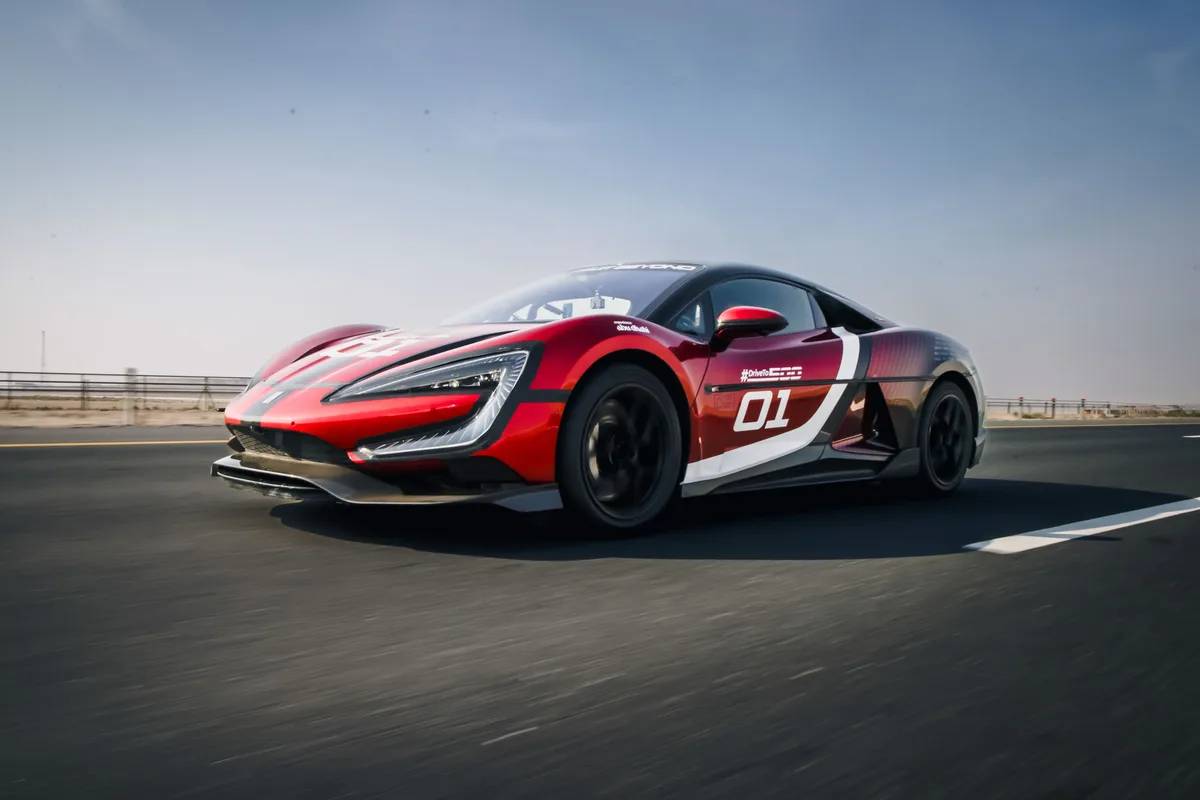
Two days on a closed highway in Abu Dhabi
On November 1, 2026, German racing driver Marc Basseng took a Yangwang U9 Xtreme to 503.17 km/h on the E11 in Abu Dhabi's Al Dhafra Region. The FIA's announcement calls it the first production car past 500 km/h.[1]
It took two days. Two runs on October 31 topped out at 490 km/h, so engineers changed the rear-wing angle, suspension software and tire pressures overnight. The first run on November 1 confirmed the gains, and the second set the number.[7]
Authorities closed about 10 km of road, leaving a straight of seven kilometers. The road sits in the desert and carries daily traffic, so crews swept it and then checked for wire particles that could damage the car or its tires.[7]
Basseng also drove the previous best, 496.22 km/h, at the ATP proving ground in Papenburg, Germany, in September 2025. Abu Dhabi added 6.95 km/h to that figure, after a climb that started at 309 km/h less than three years earlier.[1]
| Date | Car | Speed | Place |
|---|---|---|---|
| January 2024 | U9 | 309 km/h (192 mph) | Wuhan, China |
| October 2024 | U9 | 391.94 km/h (243.5 mph) | ATP Papenburg, Germany |
| August 2025 | U9 Xtreme | 472.41 km/h (293.5 mph) | ATP Papenburg, Germany |
| September 2025 | U9 Xtreme | 496.22 km/h (308.3 mph) | ATP Papenburg, Germany |
| November 1, 2026 | U9 Xtreme | 503.17 km/h (312.65 mph) | E11, Abu Dhabi |
The crash that came out first
Video and photos of a wrecked U9 Xtreme appeared in China on November 2, one day after the Abu Dhabi run and four days before BYD announced it. CarNewsChina's report that morning still described the UAE attempt as ahead.[8]
BYD has not dated the crash. Motor1 says it reportedly came days before the planned attempt and Electrek calls it an earlier test, so we read the order as crash first, record second.[4][9]
Electrek reports that BYD shared the footage itself. It describes runs above 350 km/h and then 420 km/h, and a third aimed past 450 km/h, when the car lost control, hit a guardrail and kept spinning.[10]
The impact speed is unconfirmed. Headlines saying 280 mph describe the target, and one report puts the first hit near 360 km/h. BYD has published neither a speed nor a cause.[10][11][4]
The impact tore the rear axle assembly away and wrecked the bodywork at both ends. The central passenger compartment looked largely intact, and no battery fire was reported.[4][5]
BYD says a hospital found the driver in good health after a full medical exam, with no serious injuries. CarNewsChina reports that he got out of the car on his own.[10][8]
Testing carried on. Electrek says the next run reached 457.89 km/h, or 284.5 mph, and that BYD closed its film with a line translated as, "The ultimate pursuit has no end; the summit will eventually be reached."[10]
If BYD did publish this itself, that is an unusual move for a company selling a $3 million car. We would still like to see the part it left out, which is why the car lost control.
Why SSC still has a claim
Guinness lists the 503.17 km/h as the highest speed by a production car in a single-direction run. That last phrase carries the whole argument.[1]
Production-car records have traditionally averaged two passes in opposite directions, which cancels most of the help or harm from wind and road grade. Yangwang declined to set a two-way average, according to evo.[2][9]
SSC's Tuatara holds that mark at 282.9 mph, or 455.3 km/h, set at Kennedy Space Center on January 17, 2021. Its two passes came in at 279.7 and 286.1 mph, a gap of 6.4 mph between directions on one afternoon.[3]
Even so, 503.17 km/h sits almost 48 km/h above the Tuatara's average, far more than the roughly 10 km/h between SSC's own two passes. We would bet the U9 Xtreme could beat SSC's two-way figure, but BYD has not shown it.
Arguments in this class have a history. Bugatti's 304.77 mph in 2019 came from a modified Chiron that did not qualify, and Bloomberg wrote that SSC's own record will always carry an asterisk after its disputed first attempt.[12]
Our reading: call the U9 Xtreme the fastest production car in one direction, and leave the two-way title with SSC until someone runs it both ways.
Tires set the ceiling
The U9 Xtreme has four motors rated at 555 kW, or 755 PS, each, for more than 3,000 PS combined on a 1,200-volt system. Each motor spins up to 30,000 rpm, and the car makes 1,217 PS per ton.[7][6]
Power gets a car toward 500 km/h. Staying intact there is the tires' job. By our math, a tire with a 2.2-meter circumference turns about 63 times a second at 503 km/h, with heat building inside where nobody can see it.
Giti built the GitiSport e.GTR2 Pro for this car over more than three years. It uses high-strength aramid fiber reinforcement and what Giti calls an Anti-Standing Wave Structure, meant to stop the tire deforming at extreme rotational speed.[13]
Giti says that structure was validated indoors at 500 km/h, then the tires were further optimized for the Abu Dhabi road. The company took its own Guinness title for the highest speed achieved by electric vehicle tires.[13]
BYD adds a detail you rarely see on a spec sheet: a knurled rim interface with high-viscosity lubricant, there to stop the tire slipping on the wheel. Few road cars ever have to think about that.[7]
Reports say only that the crashed car left its line at high speed and hit a barrier. Any talk of tires or aero as the cause is a guess until BYD says more.[8][4]
What it means if you will never drive one
Production is limited to 30 cars worldwide, priced above 20 million yuan, about $2.98 million. A standard U9 starts at 1.8 million yuan. BYD does not sell passenger cars in the United States, so no American buyer is cross-shopping this.[6]
Electrek also points out that it is unclear whether those 30 customer cars get the semi-slicks that set the record. That would change what the number means for an owner.[9]
BYD's announcements give no service schedule, tire price or battery repair policy. On a 30-car run, each owner depends on whatever support BYD chooses to build, and we would want that in writing before signing.
For the rest of us, the hardware is the story to follow: 1,200-volt electrics, 30C battery discharge and motor control at this level could reach cheaper models. BYD has given no timeline, so we count that as a hope for now.[7]
The run does settle one old assumption about who builds the fastest cars. evo notes that no Bugatti, Koenigsegg or Hennessey has reached 500 km/h, and a Chinese carmaker now has.[2]
Frequently Asked Questions
How fast did the Yangwang U9 Xtreme go?
It reached 503.17 km/h, or 312.65 mph, on November 1, 2026, on a closed section of the E11 in Abu Dhabi, with Marc Basseng driving. The FIA recognized the speed.
Is the U9 Xtreme the fastest production car in the world?
In a single direction, yes, under Guinness's category. The SSC Tuatara still holds the two-way production-car average of 282.9 mph, or 455.3 km/h.
When did the U9 Xtreme crash?
BYD has not given a date or named the closed track in China where it happened. The footage appeared on November 2, 2026, and reports place the crash before the Abu Dhabi attempt.
Was the driver hurt?
BYD says a hospital exam found no serious injuries, and CarNewsChina reports that the driver got out of the car on his own.
How much does the U9 Xtreme cost?
More than 20 million yuan, about $2.98 million, with production limited to 30 cars. BYD does not sell passenger cars in the United States.
How we researched this
This article was assembled from 13 cited references.
Nothing here is based on hands-on testing. Where a figure or finding appears, it belongs to the source cited beside it, and the writing says so rather than implying otherwise. Every source is listed below so you can check it.
Sources
- YANGWANG U9 Xtreme surpasses 500 km/h with speed achievement recognised by the FIA
- Yangwang's U9X breaks the 500km/h barrier, but SSC's record still stands | evo
- SSC Tuatara sets land-speed record for production cars at 282.9 mph | Motor Authority
- Chinese Hypercar Crashes During Testing: Video | Motor1
- BYD's 300-MPH Electric Hypercar Crashed During Testing. The Driver Survived | InsideEVs
- BYD Yangwang U9 Xtreme breaches 500 km/h barrier to set new world record for production cars | CnEVPost
- The fastest gets faster: YANGWANG U9 Xtreme tops 500km/h to set new global speed record in Abu Dhabi | BYD
- BYD's 3 million USD supercar Yangwang U9 Xtreme crashed in China | CarNewsChina
- BYD's electric hypercar hits 312 mph, first production car over 500 km/h | Electrek
- BYD's EV crashes at 280 mph: Watch driver escape unharmed | Electrek
- BYD's 3,000 HP Hypercar Crashes at 360 km/h, Driver Survives | Gumtree
- An American Automaker Claims World's Fastest Car Title, Again | Bloomberg
- Giti Tire Sets Guinness World Records Title with YANGWANG U9 Xtreme | Giti Tire
Related Articles
BYD Yangwang Altior Review
Explore the BYD Yangwang Altior review covering its luxury, four-motor tech, performance, range, and ownership insights in this ultra-luxury electric
Aston Martin Valhalla Spider Performance
Explore Aston Martin Valhalla Spider performance, roof-off top speed, and active aero tech that keeps this hypercar stable at 217 mph.

Audi $4 Billion U.S. Factory
Explore Audi's $4 billion U.S. factory plan, tariff impacts, production details, and political controversies surrounding the Georgia plant investment.
Electric Vehicle Range Tests and New EV Developments
Explore electric vehicle range tests, efficiency, and new EV developments to understand real-world performance and ownership factors.